烟草成分深度解析——不同烟草品种的主要化学成分对比
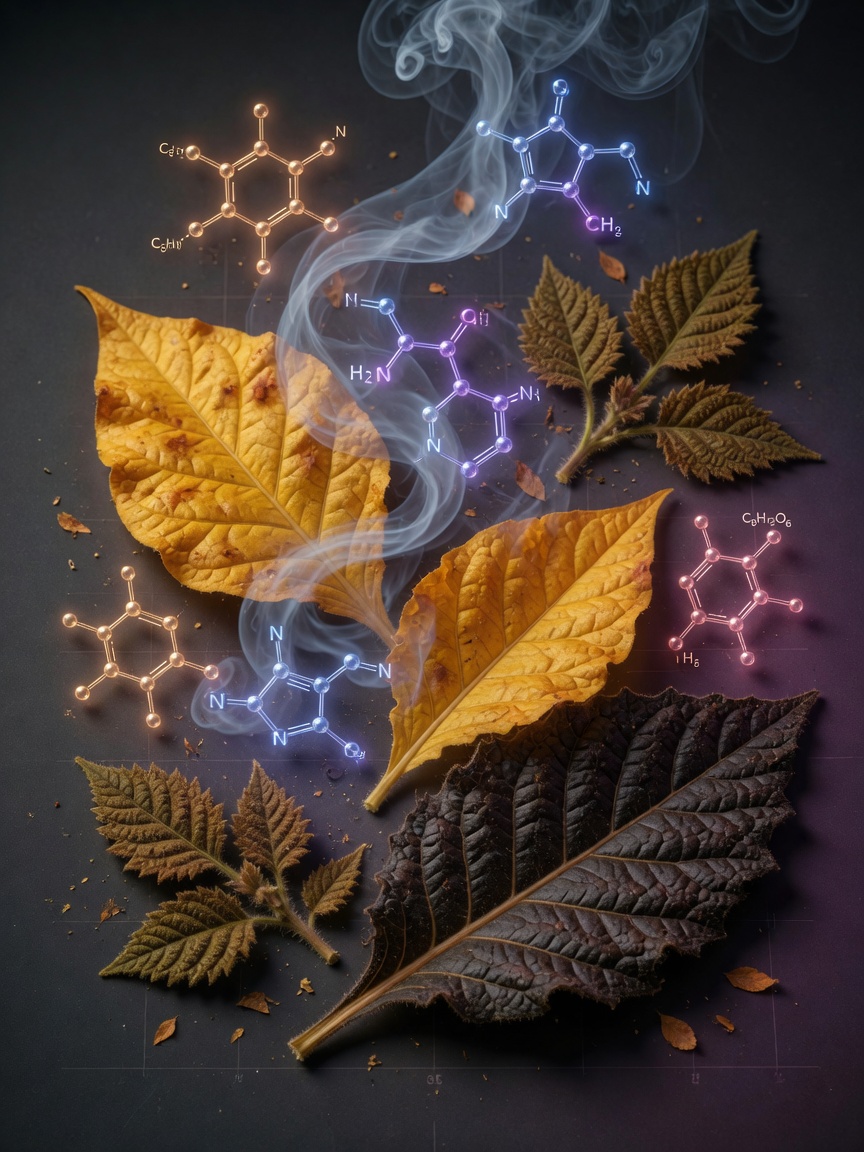
In-depth Analysis of Tobacco Components — Comparison of Main Chemical Components Among Different Tobacco Varieties
Many people talk about tobacco based on whether it "tastes good," "is strong," or "is sweet"; but what truly determines these sensations is a series of measurable chemical components in the tobacco leaf, and the complex smoke system generated after combustion (or heating). Different tobacco types (flue-cured, burley, oriental, sun-cured, etc.) and varieties (such as Honghua Dajinyuan, K326, Yunyan series, etc.) show significant differences in nicotine, sugars, organic acids, phenols, etc., and these differences are further amplified by plant part, maturity, curing process, and growing region.
This article starts from the main chemical components, compares the component characteristics of common tobacco types and representative varieties, and explains how they affect taste and irritation. Two points need to be stated upfront:
I. First, Clarifying "Tobacco Types"
Before discussing components, several concepts often conflated need to be distinguished:
| Concept | Meaning |
|---|---|
| --------- | --------- |
| **Plant species** | Cultivated tobacco is mostly common tobacco (*Nicotiana tabacum*), with a small amount ofNicotiana rustica (*N. rustica*, often higher in nicotine) |
| **Tobacco type** | Classified by curing method and use: flue-cured, air-cured (burley, Maryland, etc.), sun-cured, oriental, etc. |
| **Variety** | Genetic material, such as Honghua Dajinyuan, K326, Yunyan 87, NC series, etc. |
| **Plant part/Grade** | Lower, middle, upper leaves; maturity and grade significantly alter nicotine, sugar, nitrogen, etc. |
1. Flue-cured Tobacco
Cured in a bulk curing barn by controlling temperature and humidity through yellowing, leaf-drying, and stem-drying stages. Typical characteristics are higher sugar content, moderate nicotine, and a relatively "sweet, roasted" aroma, making it the main component of most cigarette blends. China's main producing areas relate to Yunyan, Qianyan, Xiangyan style regions; varieties like Honghua Dajinyuan, K326, Yunyan 85/87 are widely discussed.
2. Burley Tobacco (an important air-cured type)
Has a genetic chlorophyll-deficient stalk and is air-cured. Typical characteristics are almost no or very little reducing sugar, relatively high nicotine and nitrogen compounds, and a tasting profile leaning toward "strength" and "nut/cocoa" notes, making it a backbone ingredient in blended cigarettes (American blend), often treated with casings and flavors.
3. Oriental/Turkish Tobacco
Small leaves, grown in sunny, relatively poor or specific ecological conditions, mainly sun-cured. Nicotine is usually low, with unique essential oils and aroma compounds, imparting "spicy, fatty, resinous" notes. The amount used may not be large, but the style contribution is prominent.
4. Sun-cured Tobacco (sun-cured red, sun-cured yellow, etc.)
Primarily cured by sunlight. Sun-cured yellow can approach some flue-cured characteristics; sun-cured red often differs more from flue-cured, with relatively low sugar, and nitrogen and nicotine characteristics varying by variety and sun-curing process, commonly used in cigar filler, local specialty tobacco, or snus and other traditional uses (specific products vary by regulation and process).
5. Maryland Tobacco and Other Air-cured Types
Thin leaves, good burn, high filling power, chemically often falling between certain air-cured characteristics, used in specific blend formulations.
**Summary**: When discussing "component comparison of different tobacco varieties," a more accurate statement is often — **comparing the relative differences brought by varieties and growing regions within the framework of tobacco types**.
II. Core Component Overview: A "Relative Difference" Comparison Table
The table below uses relative highs and lows to describe typical trends (not actual measured values from a single laboratory). Actual tobacco leaves are heavily influenced by plant part (upper leaves often have higher nicotine), maturity, climate, fertilization, and curing.
| Component Dimension | Flue-cured (Typical) | Burley (Typical) | Oriental (Typical) | Sun-cured Red, etc. (Overview) |
|---|---|---|---|---|
| --------------------- | ---------------------- | ------------------ | -------------------- | ------------------------------- |
| **Nicotine** | Moderate | Moderately high~High | Low~Moderate | Moderate~High (varies by type) |
| **Total sugar/Reducing sugar** | High | Extremely low | Low~Moderate | Sun-cured yellow can be high, sun-cured red often low |
| **Sugar/Nicotine ratio** | Relatively high → greater potential for smoothness | Very low → strength and irritation easily prominent | Depends on nicotine and sugar combination | Highly variable |
| **Total nitrogen/Proteins** | Moderate | Relatively high | Low~Moderate | Often high or structurally different |
| **Organic acids** | Relatively high, with spectrum influencing sweetness and smoothness | Different spectrum, acidity coupled with strength | Coexisting with essential oils, distinct style | Varies by curing |
| **Polyphenols/Phenols** | Moderate~high, related to color, astringency, and some aroma notes | Characteristic phenol spectrum | Interwoven with aroma compounds | Changes significantly after curing |
| **Typical sensory impression** | Sweet, roasted, relatively "full" | Strong, dry, nutty/baked notes | Spicy, fatty, penetrating | Intense or distinct local style |
This table is only a "map." Below, each component is broken down: what it is, why it differs across types, and how it becomes taste and irritation.
III. Nicotine: The Core of Satisfaction, Also the Core of Addiction
1. What It Is
Nicotine is the most important alkaloid in tobacco, accounting for the vast majority of total alkaloids. It acts on the central and peripheral nervous systems, producing effects such as stimulation, illusion of relaxation, increased heart rate, and is the main pharmacological basis of tobacco addiction. During combustion, part of the nicotine enters the mainstream smoke, and part is pyrolytically converted.
2. Type and Variety Differences (Trends)
3. Impact on Taste and Irritation
4. Cognitive Correction
"High nicotine" does not mean "low tar equals safety"; "low nicotine" does not mean "you can smoke freely." Addiction, cardiovascular effects, and the carcinogenic risk of combustion products are issues at different levels.
IV. Sugars: The Chemical Foundation of Sweetness, Smoothness, and "Roasted Aroma"
1. What Are Total Sugar and Reducing Sugar
Soluble sugars in tobacco leaves mainly include reducing sugars such as glucose and fructose, as well as sucrose. During the yellowing stage of flue-curing, starch is hydrolyzed, and reducing sugars accumulate significantly; in burley air-curing, respiratory consumption is high, and sugars are largely depleted, resulting infinished leaves exhibit an almost"sugar-free"characteristic. This is one of the most classic and stable chemical distinctions between flue-cured and burley tobacco.
2. Type Comparison
| Type | Sugar Characteristics | Sensory Association (Overview) |
|---|---|---|
| ------ | ----------------------- | -------------------------------- |
| Flue-cured | High total sugar and reducing sugar | Sweetness, rich caramel/roast precursors, relatively "smooth" smoke |
| Burley | Extremely low sugar | Dry, direct strength, relies on casing for sweetness and aroma |
| Oriental | Low~moderate sugar, butaccompanied by unique volatile compounds | Sweetness is not theprimary role, aroma layering is |
| Sun-cured yellow | Can approach flue-cured | Relatively smooth potential |
| Sun-cured red | Often low sugar | Strong, off-notes and strength management more dependent on processing |
At the variety level: within the same flue-cured type, Honghua Dajinyuan is often described as having prominent aroma style and coordinated chemistry; K326 etc. show different performance in resistance, yield, and chemical stability; the Yunyan series have reported differences in total sugar, nicotine, and potassium-chloride across regions. These are "tendencies," not absolute labels.
3. How Sugar Affects Taste and Irritation
An industry coordination indicator. When the ratio is higher, it subjectively feels smoother, less irritating, sweeter; when too low, it tends to be harsh, dry, uncomfortable on the throat. Burley itself has an extremely low sugar/nicotine ratio, so formulation and casing are "hou tian xie tiao (post-curing coordination)."
During combustion/heating, sugars and amino acids participate in the Maillard reaction, generating numerous aroma compounds (roasted, nutty, caramel notes). This is the chemical reaction behind the "good smell, good taste" narrative of flue-cured tobacco, not that "sugar itself is harmless."
High sugar can partiallymitigate harshness, but combustion still produces irritants such as aldehydes. Sweet ≠ low harm. For those with sensitive nasal passages and throats, even sweet smoke can still cause dryness and inflammation.
When sugar is high and curing is proper, it helps suppress green off-notes; if curing is improper (e.g.,ash-hanging (a curing defect where ash adheres), excessive starch residue), sweetness and off-notes may coexist, producing contradictory sensations of "cloying" and "raw."
V. Organic Acids: Smoothness, Delicacy, and the "Sweet-Sour Framework"
1. Roles of Common Organic Acids
Non-volatile organic acids in tobacco leaves include malic acid, citric acid, oxalic acid, etc.; there are also volatile acids and higher fatty acids related to aroma. Organic acids can:
2. Type and Variety Differences
In varietal comparison studies, the distribution differences of non-volatile organic acids in palisade and spongy tissues also indicate that different cell structure layers of the same leaf affect measurable components — which further reminds us that simple "variety A has high acid, variety B has low acid" statements needspecifying the sampling position and method.
3. Impact on Taste and Irritation
VI. Phenols and Polyphenols: Color, Astringency, Aroma, and Smoke Phenols
1. Phenols in Tobacco Leaves
Includes polyphenols such as chlorogenic acid, rutin, scopoletin, and phenolic structures related to lignin. They affect:
After combustion, phenolic compounds such as phenol, o-cresol, m/p-cresol can be detected in mainstream smoke; different varieties and origins of single-grade tobacco can show differences in smoke phenol profiles. Smoke phenols are related to irritation and odor characteristics and are also a category in harmful component discussions.
2. Type and Variety Trends
3. Sensory Implications
For those with sensitive nasal passages, phenols together with aldehydes, particulate matter, etc. constitute mucosal irritation load — this can coexist with "good aroma": the aroma may be pleasant, yet still irritating.
VII. Other Key Components: Total Nitrogen, Potassium-Chlorine, Aroma Precursors
1. Total Nitrogen and Proteins
High nitrogen is often associated with strength, irritation, bitterness, and off-notes from protein pyrolysis. Burley's relatively high total nitrogen is part of its style origin and also a difficulty in irritation management. If flue-cured tobacco has excessive nitrogen and insufficient sugar, it tends to be "harsh,harsh,off-notes."
2. Potassium and Chlorine
The "potassium-chlorine ratio" is a common indicator in tobacco quality evaluation. Some varieties/plots have high chlorine and low potassium, significantly compromising chemical coordination — this is also an origin and soil issue, not solely a variety issue.
3. Aroma Precursors and Solanesol, etc.
Carotenoid degradation products, browning reaction products, neophytadiene, solanesol, etc. are related to aroma quality and quantity. Different regions, varieties, and plant parts can show statistical differences in solanesol and other content, correlated with some smoke components. For consumers, there is no need to remember molecular names; just understand: "aroma" is the product of a long chain of precursors during curing and combustion, not something a single flavoring can fully represent (even though modern cigarettes extensively use flavoring and casing).
VIII. From Chemistry to Sensory: A "Causality Chain" Summary Table
| What You Perceive | More Likely Chemical/Processing Background |
|---|---|
| ------------------- | -------------------------------------------- |
| Fast kick, throat harshness | High nicotine delivery, high freebase proportion, alkaline smoke, low sugar, high nitrogen |
| Sweet, caramel-like | Flue-cured high reducing sugar + Maillard/caramelization products |
| Dry, throat tightness | Low sugar, high phenols/high nitrogen, incomplete combustion, insufficient humectants (in finished products) |
| Off-notes, raw | Insufficient maturity, improper curing, nitrogen metabolism and chlorophyll-related residues |
| Delicate, penetrating aroma | Oriental essential oil contribution, coordinated acids and volatiles, proper blend proportion |
| Bitter, astringent, puckering | High polyphenols, phenolic combustion products, over-mature or stem-drying color-fixing issues |
| "Empty, thin" | High filling power but insufficient aroma precursors, too low plant part, excessive dilution (ventilation), etc. |
Taste** is more a combination of aroma + sweetness/smoothness + aftertaste; **Irritation** is more a combination of pH, nicotine form, aldehydes/phenols, particulate deposition, and individual mucosal sensitivity. They can go in the same direction or diverge (e.g., very aromatic but very harsh).
IX. Plant Part, Maturity, Curing: More Important Amplifiers Than "Variety Myth"
1. Plant Part
Comparing upper, middle, and lower leaves of the same variety often yields more "dramatic" differences than comparing middle leaves of two different varieties.
2. Maturity
Under-ripe: High starch, insufficient sugar conversion, risk of green off-notes.
Properly ripe: Sugar, alkaloids, and nitrogen more easily enter thequality window.
Over-ripe: Possible aroma loss, increased risk of disease spots and component imbalance.
3. Curing
Therefore, the "variety comparison" in the article title should be understood as: Genetics provide the upper and lower limits and style potential; environment and process write the final chemicalfinal answer.
X. Health Perspective: After Understanding Components, Understand the Risks
Sugar improves sensory qualities, not tar carcinogenicity, nor carbon monoxide's impact on the cardiovascular system.
Smokers often compensate by inhaling deeper and taking more puffs, so actual exposure may not decrease.
The component differences between burley and flue-cured explain style differences, not "which one is safe to smoke" — the answer is: Neither can be recommended from a health perspective.
Phenols, aldehydes, particulate matter, and nicotine itself all irritate mucous membranes. If you are concerned about rhinitis, pharyngitis, or olfactory issues, the core strategy is to reduce or stop smoke exposure, not to finely pick "a less irritating combustible smoke" among types.
5. Harm reduction narratives should be cautious
Heated tobacco products and e-cigarettes have different exposure profiles compared to combustible cigarettes, but they are not risk-free, nor can they be simply extrapolated from the component comparison in this article; independent evidence assessment is needed.
XI. Conclusion
Different tobacco types and varieties do show explainable chemical differences in nicotine, sugars, organic acids, phenols, and other dimensions:
These differences shape taste and irritation through sugar/nicotine ratio, pH and nicotine form, Maillard products, polyphenol astringency, nitrogen metabolism off-notes, and other pathways. At the same time, plant part, maturity, curing, and growing region often determine the smoke you ultimately inhale more than "variety name" alone.
Understanding components is aboutdemystify marketing rhetoric, seeing clearly the sources of satisfaction and irritation; at the health level, the most effective "component management" remains: reduce tobacco smoke exposure, seek professional smoking cessation support when necessary (including nicotine replacement therapy and other medical approaches) — that is another evidence-based practical path, strictly distinguished from "tasting tobacco leaf styles."
Appendix: Self-check Questions for Reading and Understanding
Keep these questions in mind, and you will be much moresober when looking back at any "component," "burst bead," or "aging" claims.
This article is a popular science component analysis, does not constitute medical advice, and does not encourage tobacco use. Component relative relationships are compiled from commonpatterns and principles in tobacco chemistry and leaf quality evaluation; please refer to authoritative testing and peer-reviewed research for specific values.